
Criminal Cases in the Wilbarger County Courts
Wilbarger County criminal court cases are divided by charge level. The Wilbarger County District Clerk receives and preserves felony filings for the 46th Judicial District Court. Its work includes docketing each filing, issuing court papers when directed, collecting court costs, and retaining the case through disposition, appeal, and later proceedings. County Court misdemeanors belong with the County Clerk. Fine-only city cases may be held by Vernon Municipal Court, while fine-only precinct matters may belong to a Justice Court. There is no one local counter that merges all four dockets.
The best first clue is the cause number, which identifies the court and case. If that number is unknown, use a full name and a narrow filing-year range. Ask the clerk to confirm that the office has the case before requesting copies. An arrest location alone does not settle the question because the arresting agency, booking jail, charging prosecutor, and trial court keep different records.
The official District Clerk page shows the local felony custodian and its public contact route.
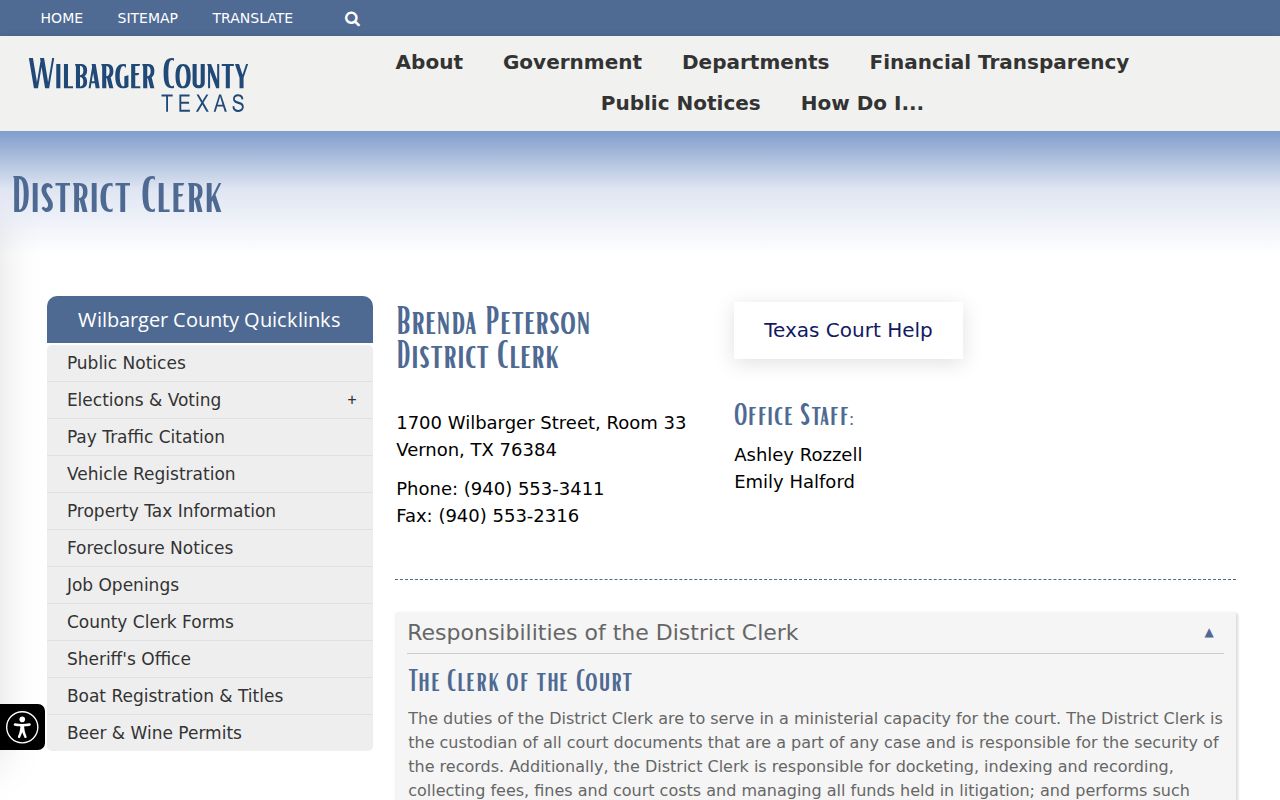
That office is the authoritative stop for a signed felony judgment even when another database offers a case summary.
Wilbarger Court Case Levels Compared
Texas Penal Code Chapter 12 helps explain the local split. Capital, first-degree, second-degree, third-degree, and state jail felonies go to District Court. Class A and Class B misdemeanors go to County Court. A Class C misdemeanor is fine-only and may be in Municipal or Justice Court, based on the offense and filing authority. Enhancements may change the punishment range, so a roster label or early charge should never replace the charging instrument and judgment.
The Wilbarger County Clerk page identifies the clerk for County Court proceedings.
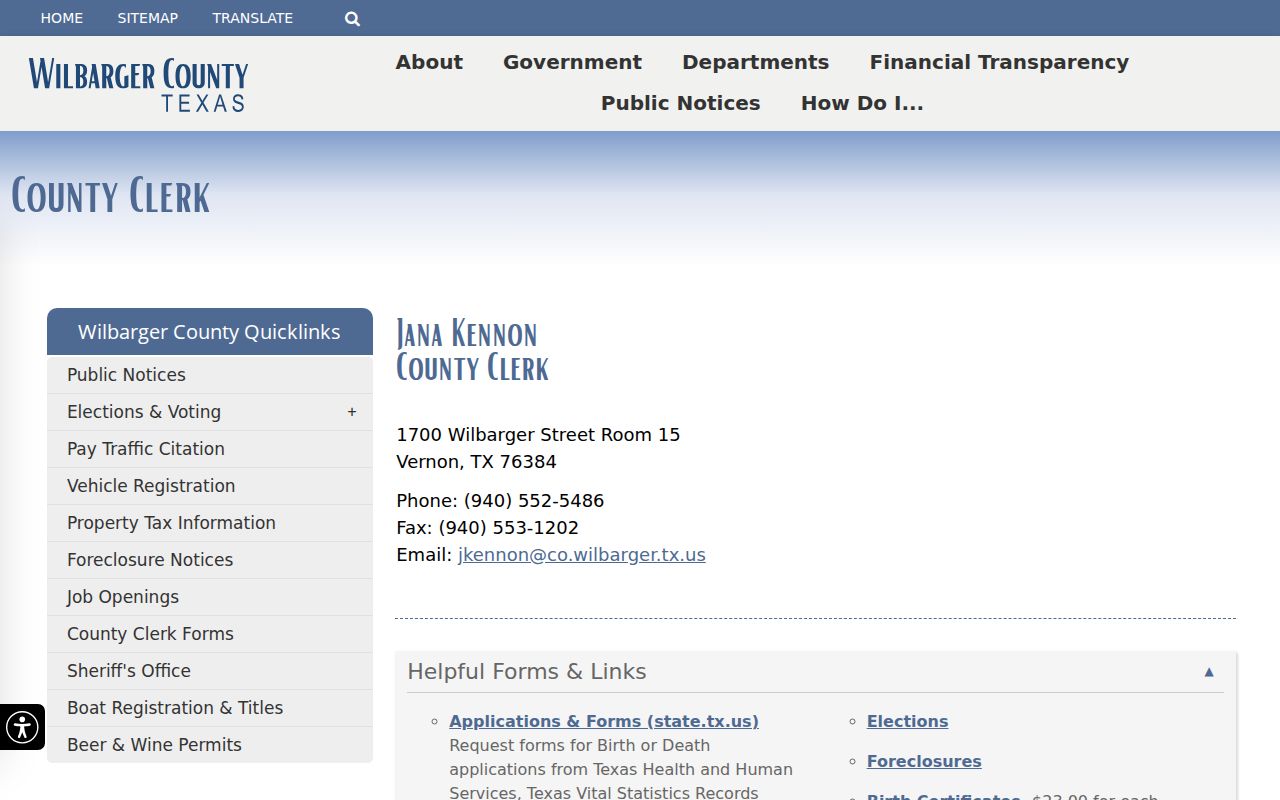
This court-level check prevents a common error: asking the felony clerk for a misdemeanor file, or asking the county clerk for a Vernon fine-only citation.
How to Search Case Records
No official Wilbarger County online criminal case portal or local copy-fee table was found. Phone, mail, and in-person requests are therefore core access channels, not minor backups. The District Clerk is in Room 33 at 1700 Wilbarger Street, Vernon, Texas 76384, and can be reached at (940) 553-3411. The County Clerk is in Room 15 at the same courthouse and can be reached at (940) 552-5486. Published county hours are Monday through Friday, 8:00 a.m. to 5:00 p.m. Call before travel and ask about current search, copy, certification, payment, pickup, mail, and electronic-delivery options.
Written requests can also use the District Clerk fax at (940) 553-2316 or the County Clerk fax at (940) 553-1202. The County Clerk publishes jkennon@co.wilbarger.tx.us. Confirm that an email or fax is appropriate for the requested court record before sending personal identifiers. Mail should name the clerk and courthouse address, identify the existing case record, and state the desired copy type and delivery method.
- Identify the likely court from the charge level, citation, or cause number. Start with District Clerk for a felony and County Clerk for a Class A or B misdemeanor.
- Give the full name, approximate filing year, and cause number if known. Ask staff how its public index can be searched.
- Request the register or docket first. Use its entries to name the charging instrument, bond order, motions, judgment, sentence, or other filings needed.
- State whether a plain, certified, or exemplified copy is required. Ask for the verified page, search, and certification price before ordering.
- Choose an available delivery method and confirm accepted remote payment. Check the clerk's signed disposition against any state portal summary.
re:SearchTX and Wilbarger Criminal Cases
re:SearchTX is the named statewide court portal. It requires registration or eFileTexas credentials and offers case, filing, document-text, and hearing searches. Its result tools can filter, export, and save a search. Yet an official Judicial Council report said the large historical collection dating from 2016 excluded criminal case records at that time. Live coverage can change, so readers should test the portal without treating an empty result as proof that no Wilbarger County case exists.
The official re:SearchTX landing page illustrates the statewide account and search route.
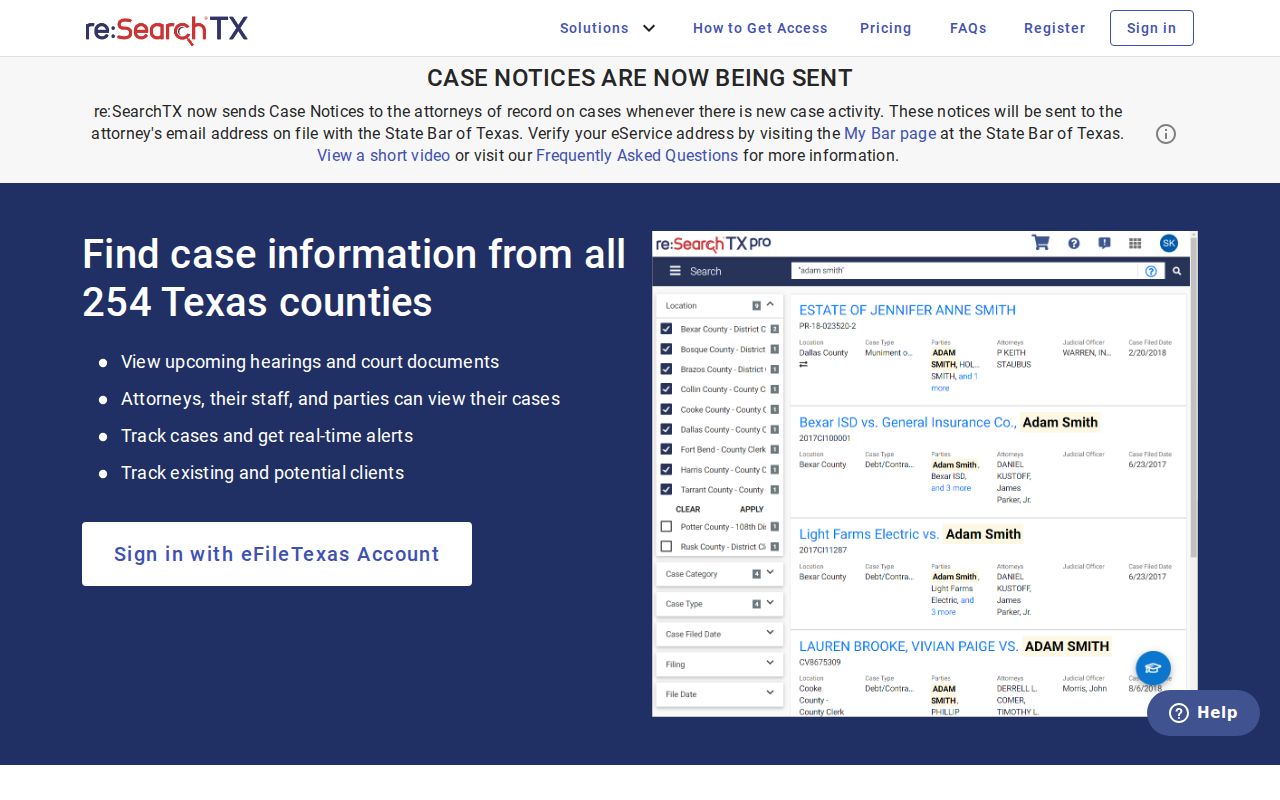
For a Wilbarger criminal docket, the portal is a discovery aid. The local clerk remains the source for complete filings, certification, and a case that the statewide index does not return.
| Field or Control | Type | Required | Use |
|---|---|---|---|
| Search | Keyword text | Search term | Submit with Enter or the search icon |
| Cases | Category tab | No | Search case descriptions and details |
| Filings | Category tab | No | Search filed items |
| Text in Documents | Category tab | No | Full text where documents are available |
| Hearings | Category tab | No | Review hearing details |
| Filter options | Result facets | No | Narrow the returned set |
| Export or Save search | Account action | No | Preserve a result set or query |
What the Case File Shows
A court case file records the filed prosecution, not just the arrest. It can show the charge accepted by the court, parties and counsel, hearings, motions, pleas, orders, judgment, sentence, costs, and status. A dismissal is a disposition. A deferred adjudication is also a court outcome, but it is not the same as a conviction. “Disposition” simply means how the court resolved a charge. Readers should use the signed judgment or dismissal order when a database label is vague.
| Case Number and Court | Identifies the exact cause and the Wilbarger court that owns the file. |
|---|---|
| Charging Document | States the offense filed for prosecution and may differ from the first booking label. |
| Docket Entries | Chronological register of filings, settings, appearances, pleas, and court orders. |
| Hearing Dates | Shows scheduled or completed proceedings, subject to later changes. |
| Disposition and Judgment | Records dismissal, acquittal, conviction, deferred adjudication, or another final result. |
| Sentence and Conditions | States confinement, fine, supervision, costs, and other terms ordered by the court. |
Texas DPS receives data from criminal justice agencies, and a repository entry can lack a later result because of delay or a linkage problem. Secure certified court proof before asking the reporting agency and DPS to correct an error.
Wilbarger Court Copies From Room 33
Room 33 is more than a name-search counter. The District Clerk receives every felony filing, records the docket, issues capiases when the court directs, collects fines and costs, and retains proceedings through appeal. A capias is a court order directing that a person be taken into custody. It is distinct from the later judgment. Bond is also separate from fines and court costs: bond addresses release while a case is pending, while fines and costs follow court action.
Ask for documents by title whenever possible. The register or docket gives that roadmap. A charging instrument shows what was formally filed. The judgment supplies the outcome. A sentence or supervision order states the terms. Plain copies can be enough for reading, while certified copies bear the clerk's certification and may be needed for an official correction or filing. An exemplified copy has added authentication. Wilbarger County has not published the relevant local prices, so request a quote instead of assuming another county's rate.
Stages of a Criminal Case
A Wilbarger County court file grows as the prosecution moves. The charging document starts the filed case. Arraignment is the stage where the charge is presented and a plea is addressed. Pretrial entries can show motions, evidence issues, settings, and negotiations. A plea or trial leads toward disposition. The judgment resolves the charge, and sentencing records the terms when punishment applies. Not every case uses every type of hearing, and the docket may change as settings move.
Case flow: Charges Filed › Arraignment › Pretrial › Plea or Trial › Disposition › Sentencing
The court sequence explains why a booking record may show an early accusation while the later case file shows a reduced charge, dismissal, acquittal, deferred adjudication, or conviction. For the custody event itself, use the county's Wilbarger County arrest history channels; for the filed outcome, return to the proper clerk.
Historic Wilbarger Criminal Court Files
The District Clerk says its records date to 1848 and are preserved through microfilming. That claimed date reaches earlier than the county organization chronology found elsewhere in the local history. A researcher should therefore ask which series and years actually survive, not assume one unbroken felony docket. The Texas State Library Wilbarger inventory points to early county microfilm held through Midwestern State University.
No online result does not mean no old file. A name may appear under a spelling variant, the index may remain on paper, or the record may require staff retrieval from film. Give the clerk the name, estimated year, likely court level, and any related party or offense detail. Historical and genealogy work often benefits from first requesting the index entry, then ordering only the pages it identifies. This keeps a broad search manageable and avoids paying for a large file before its identity is confirmed.
Access & Restrictions
Texas court access starts with a strong tradition of open judicial records, but the judiciary is not treated as an ordinary agency under the Texas Public Information Act. Ask the clerk for the court's own access process. Juvenile files, victim data, medical information, grand-jury material, sealed or nondisclosed records, and some active-case details can be withheld or redacted. A restricted field does not erase the rest of the case, and a missing online result does not prove that no file exists.
Expunction and nondisclosure are also different. Expunction under Code of Criminal Procedure Chapter 55A can direct eligible records to be removed or destroyed. An order of nondisclosure limits public release of an eligible record but still permits access by specified entities. Neither occurs merely because the charge was dismissed. Anyone reviewing their own case should obtain the disposition and ask the proper court about the applicable order and its effect.
Administrative police records follow a separate route under Government Code Chapter 552. Those may be subject to law-enforcement, privacy, motor-vehicle, and other exceptions. The court clerk is still the right place for the filed pleading, order, or judgment.
Wilbarger Federal Criminal Court Records
Federal cases arising from Wilbarger County belong to the U.S. District Court for the Northern District of Texas, not to either county clerk. PACER is the official federal docket system. It requires an account and may charge under its current fee schedule. Search by party, case number, and court, then read the docket before opening documents. Sealed material and protected identifiers will not be public.
The PACER gateway shows the separate federal search path.
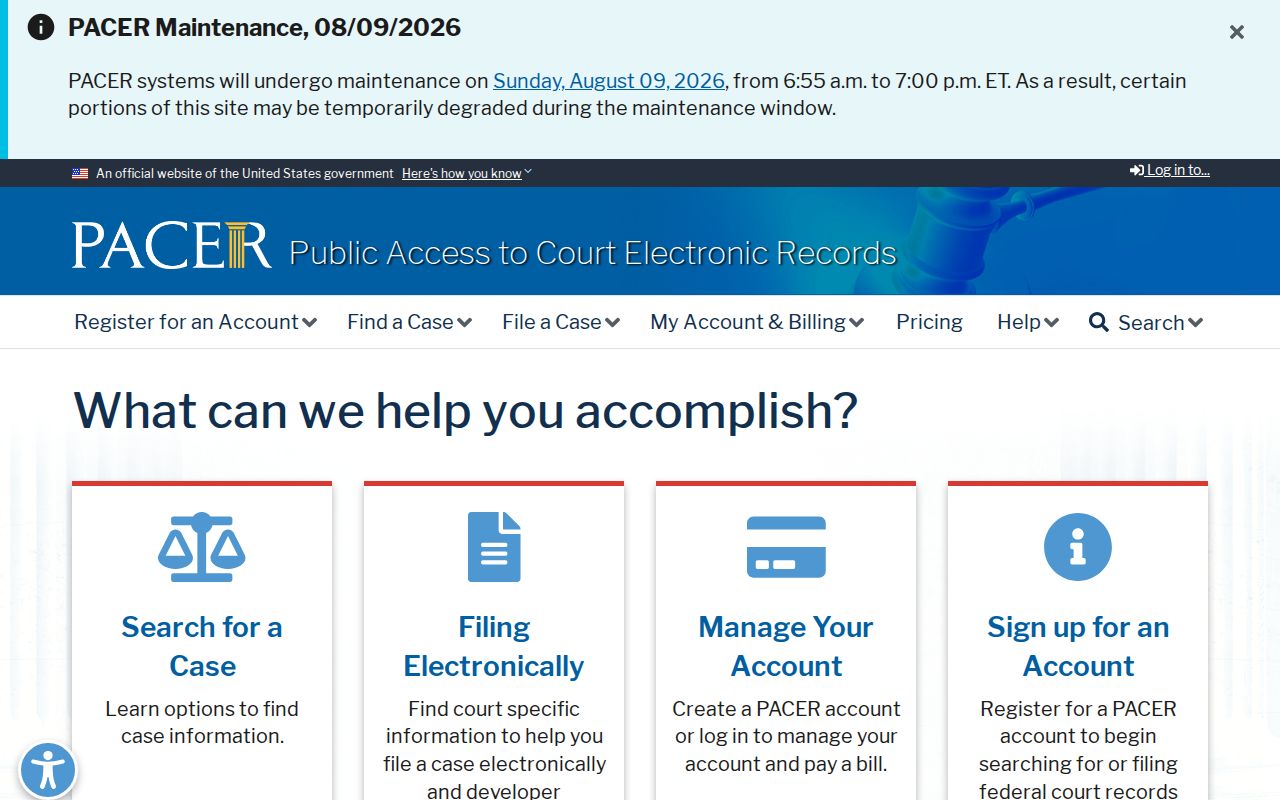
A federal docket may list the assigned judge, counsel, filings, events, and judgment. It is not an FBI criminal-history summary and does not cover state prosecutions.
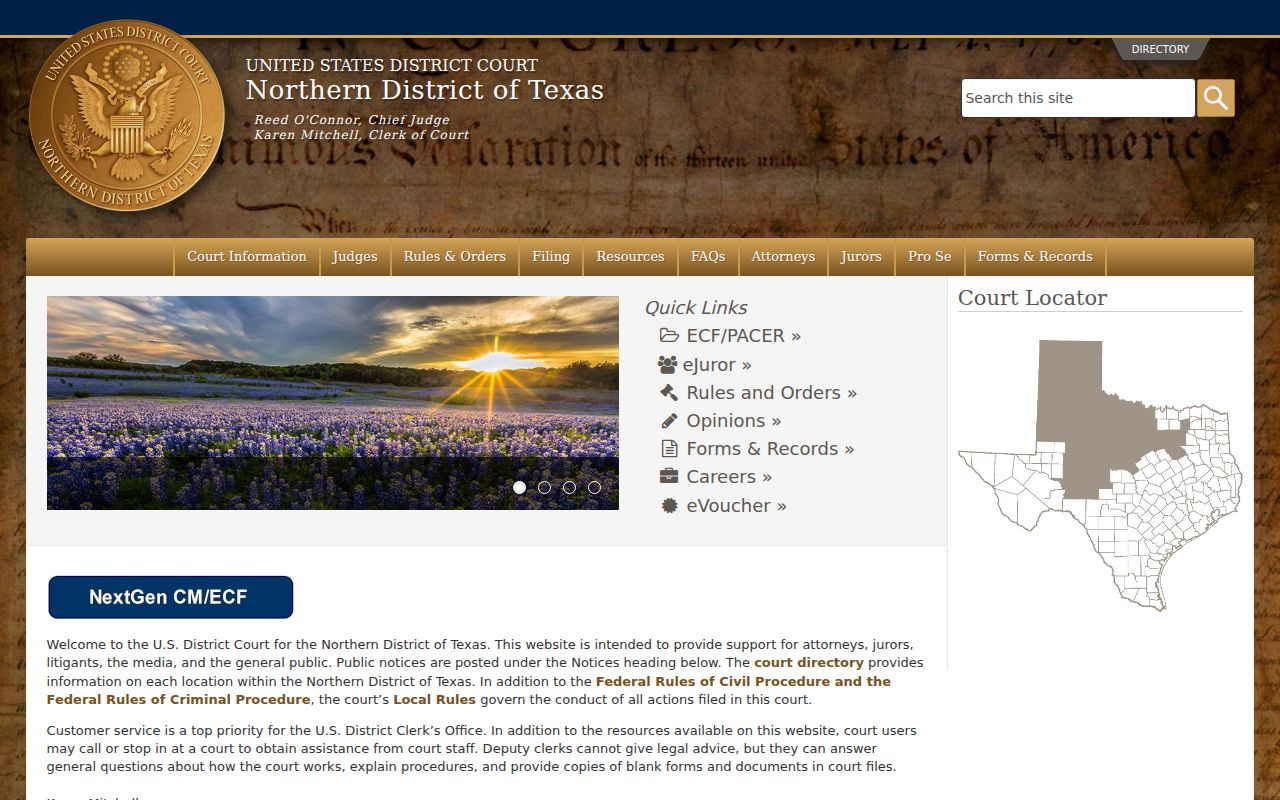
The Northern District of Texas website is the source for current district rules and divisions.
Keep the systems separate: Wilbarger clerks hold state and local cases, PACER holds federal dockets, and the FBI personal review channel is fingerprint based.